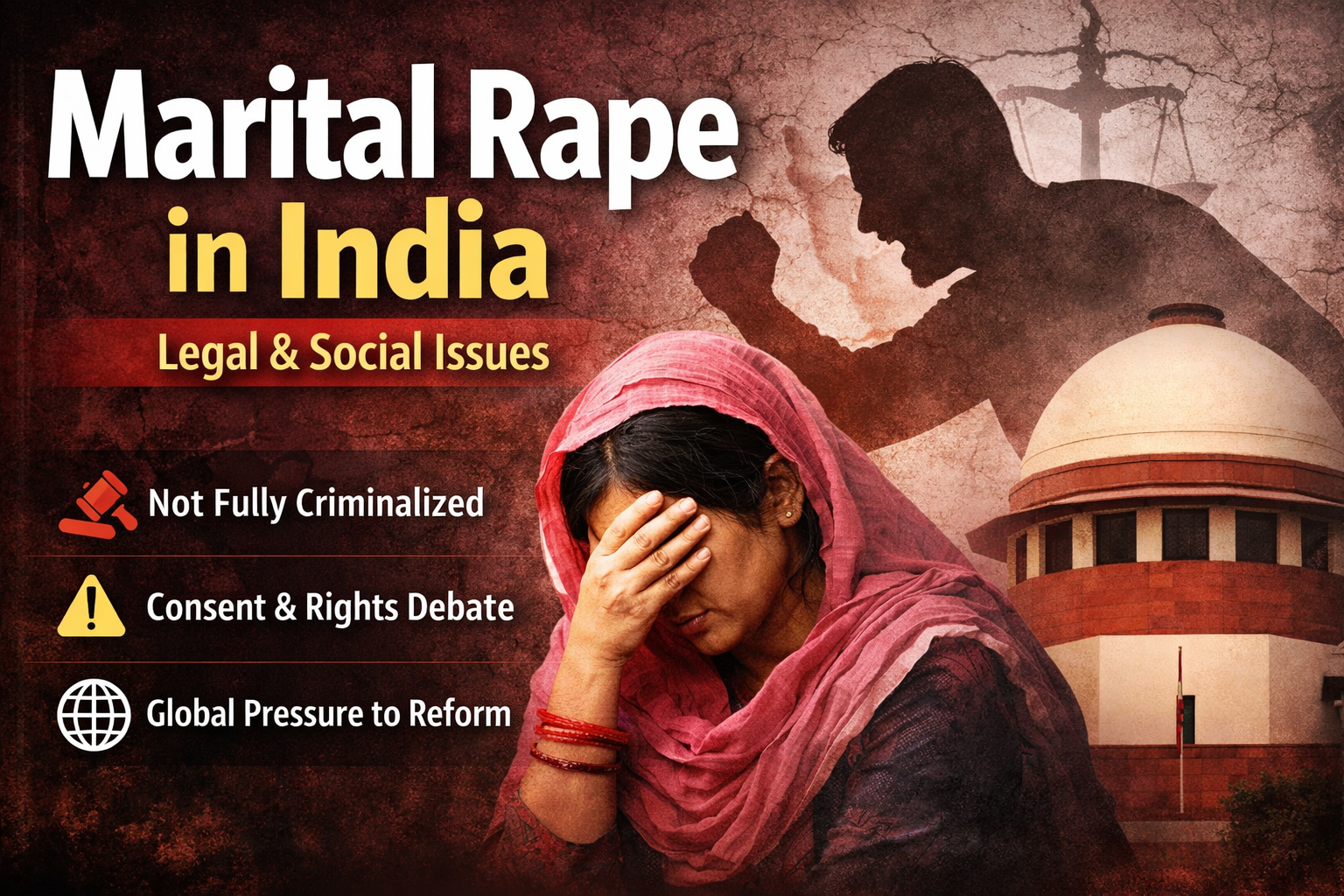
Marital Rape in India: Legal Status, Challenges & Debate (2026)
Claim Being Reviewed
"Marital rape refers to non-consensual sexual intercourse by a husband with his wife. In India, under the Bharatiya Nyaya Sanhita (BNS), such acts are generally not considered rape if the wife is 18 years or older, due to the marital rape exception. However, it is treated as rape if the wife is a minor, and women can seek protection under domestic violence and cruelty laws. As of 2026, the issue remains under legal and judicial debate, with no final decision by the Supreme Court on fully criminalizing marital rape."
Report on Marital Rape in India (2026)
1. Introduction
Marital rape refers to non-consensual sexual intercourse by a husband with his wife. In India, this issue remains legally controversial as marriage is often interpreted as implying consent, despite modern legal emphasis on individual autonomy.
2. Legal Definition and Current Law
Under the Bharatiya Nyaya Sanhita (BNS), sexual intercourse by a man with his wife (if she is 18 years or older) is not considered rape, even if it is forced. This is known as the marital rape exception.
3. Situations Where It Can Be Punished
If the wife is below 18 years, it is considered rape regardless of marriage. If the couple is legally separated, forced sexual intercourse may be treated as rape. Women can also seek protection under the Domestic Violence Act for sexual abuse.
4. Key Court Cases and Developments
The Supreme Court in Independent Thought v. Union of India ruled that sex with a minor wife is rape. In RIT Foundation v. Union of India, the Delhi High Court gave a split verdict. As of 2026, the Supreme Court has not given a final decision.
5. Arguments in Favor of Criminalization
Supporters argue that consent is essential in all relationships, including marriage. Criminalizing marital rape would align India with global human rights standards and protect women's dignity and autonomy.
6. Arguments Against Criminalization
Opponents raise concerns about misuse of the law, difficulty in proving lack of consent, and potential impact on the institution of marriage.
7. Social and Cultural Context
Traditional norms in India often view marriage as granting sexual rights to the husband. Many women are unaware that forced sex can be abuse, and social stigma discourages reporting.
8. Impact on Women
Marital rape can lead to physical injuries, mental trauma such as depression and PTSD, and long-term emotional and reproductive health issues.
9. International Comparison
Countries like the USA, UK, and Canada criminalize marital rape. India remains among the few countries where it is not fully criminalized.
10. Challenges in Reform
Legal reform faces challenges such as cultural resistance, political sensitivity, and lack of consensus among lawmakers.
11. Recommendations
Recommendations include removing the marital rape exception, increasing awareness about consent, training law enforcement, and strengthening support systems for victims.
12. Conclusion
As of 2026, marital rape remains largely unrecognized under Indian criminal law. The issue continues to evolve through legal challenges and societal change.
Frequently Asked Questions (FAQ)
1. Is marital rape illegal in India?
No, it is not fully criminalized if the wife is above 18 years.
2. Can a wife file a complaint?
Yes, under domestic violence laws or for cruelty, but not always as rape.
3. Is there any Supreme Court decision?
As of 2026, the matter is still pending before the Supreme Court.
4. Why is it controversial?
Because it involves balancing marital rights, consent, and legal enforcement challenges.
5. What is the future outlook?
Legal reforms may happen depending on court decisions and changing societal attitudes.