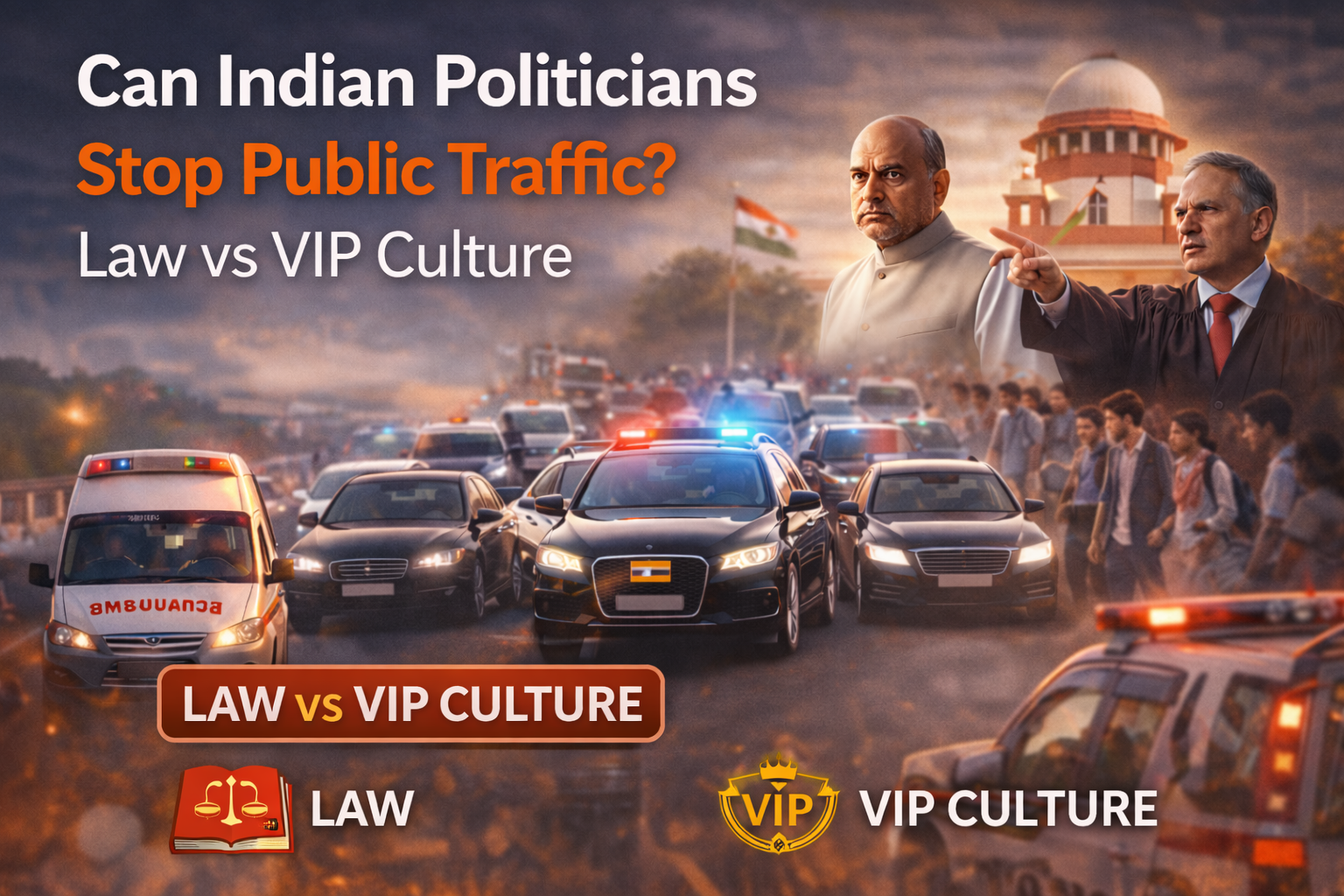
Can Indian Politicians Stop Public Traffic? What the Law and Constitution Say
Quick Summary
In India, roads are often blocked for the movement of politicians and VIPs, causing inconvenience to the public. This article examines whether such practices are legally or constitutionally justified. By analysing Article 14 of the Constitution, Supreme Court observations, and existing security laws, it explains why politicians do not have the automatic right to stop public traffic and highlights the rights of citizens in a democratic system.
Do Indian Politicians Have the Authority to Halt Public Traffic?
Legal and Constitutional Analysis
In India, it is common to see roads closed and traffic halted for the movement of politicians and other so-called VIPs. Daily commuters, students, office-goers, and even ambulances are often forced to wait while convoys pass. This raises an important constitutional question: do Indian politicians have the legal authority to obstruct public traffic and enjoy unrestricted road access?
The Short Answer
The short and clear answer is no. Indian politicians do not have an inherent constitutional or legal right to stop public traffic for their personal or political movement.
Constitutional Position: Equality Before the Law
The Indian Constitution does not grant special road privileges to politicians. Article 14 of the Constitution guarantees equality before the law, meaning that all citizens, regardless of status or position, are equal in the eyes of the law.
There is no constitutional provision that allows politicians to halt public traffic, claim exclusive use of roads, or cause inconvenience to the public for personal movement. Public roads are funded by taxpayers and are meant for common use.
Why Is Traffic Sometimes Stopped?
Traffic is not stopped because someone is a politician. It is stopped only for reasons related to security and public order.
Under Indian law, limited powers are granted to the police under the Criminal Procedure Code (CrPC) and the Motor Vehicles Act. Additionally, security protocols are issued by the Ministry of Home Affairs (MHA) and state home departments. These measures exist solely to address genuine security threats, not to provide comfort, status, or privilege.
Who Is Entitled to Security-Based Traffic Control?
Only a limited category of constitutional or high-risk individuals may receive controlled traffic movement based on threat perception.
This includes the President and Vice President of India, the Prime Minister, the Chief Justice of India, Governors and Chief Ministers (depending on threat assessment), and individuals officially granted Z+, Z, or Y category security.
Limits on Security-Based Traffic Restrictions
Even in high-security cases, traffic restrictions must be minimal, time-bound, and proportionate to the actual risk.
Public inconvenience should be avoided as much as possible, and emergency services such as ambulances, fire services, and police vehicles must never be obstructed.
What About MPs, MLAs, and Ministers?
Members of Parliament (MPs), Members of Legislative Assemblies (MLAs), and ministers do not have an automatic legal right to stop traffic.
They cannot demand empty roads for routine movement and are not entitled to VIP treatment unless a verified security threat exists. Traffic stoppages without legitimate justification amount to abuse of authority and violate citizens’ fundamental rights.
Supreme Court’s View on VIP Culture
The Supreme Court of India has repeatedly criticised the country’s VIP culture. The Court has made it clear that public convenience must override private privilege.
The judiciary has stated that roads exist for citizens, not for personal convoys, and that stopping ambulances or emergency vehicles for VIP movement is unacceptable. Security cannot be used as a shield for arrogance or entitlement.
Is the “Free Road” Culture Legal?
There is no law that permits politicians to enjoy “free roads” for personal or political purposes.
This practice continues largely due to political pressure, administrative convenience, and colonial-era notions of entitlement, but it has no legal backing under the Constitution of India.
Rights of Citizens
Citizens are not powerless in such situations. They have the right to seek information through the Right to Information (RTI) Act on why roads were blocked.
Citizens can question unjustified traffic stoppages, approach High Courts under Article 226 for violation of public rights, and raise awareness through media and civic forums. Public roads belong to the people, not to those in power.
Conclusion
In conclusion, Indian politicians do not possess any constitutional or legal authority to stop public traffic. Traffic control is justified only in genuine security situations. Routine roadblocks for convenience undermine democratic values and violate the principle of equality. A true democracy functions when those in authority follow the same rules as the citizens they serve.