Iran’s Army Chief Threatens “Preemptive” Strikes as US–Iran Rhetoric Escalates
Quick Summary
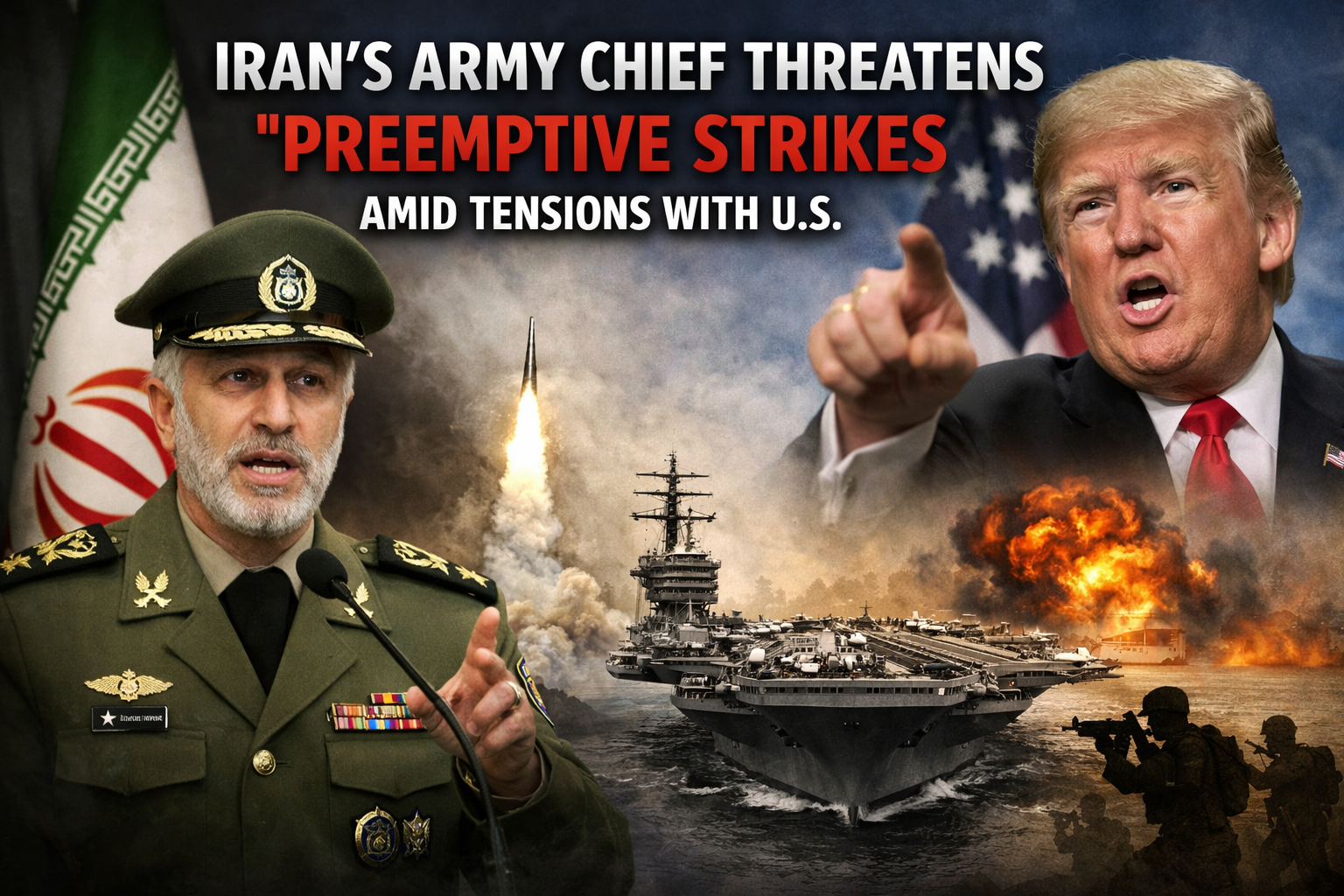
Iran’s army chief warned of possible preemptive strikes after comments by Donald Trump, further escalating already tense relations between Iran and the United States.
Iran's army chief threatens "preemptive" strikes as US-Iran rhetoric escalates.
Tensions between Iran and the United States rose this week as Iran's senior army commander warned that Tehran may strike before an attack—an unusually strong statement in the midst of rising discontent within Iran and sharper warnings from Washington.
On January 7, 2026, Iran's army chief, Maj. Gen. Amir Hatami, stated that Iran would not tolerate what he called escalating "rhetoric" and threats directed at the country, implying that Tehran may respond with preemptive military action if it believes an attack is planned.
What caused the threat?
Hatami's remarks were widely interpreted as a response to US President Donald Trump's public warning that the US would intervene if Iranian authorities "violently" suppressed protesters—language that Iranian officials see as direct interference and a potential pretext for military action.
This debate takes place at a time when Iran's domestic situation is tumultuous. Demonstrations sparked by economic strain have expanded over much of the country, with reports of deaths and a high number of arrests.
Why does "preemptive" matter?
A preemptive strike is not synonymous with reprisal after being attacked. It means attacking first—on the assumption that an adversary's attack is impending. In international politics, that framing is exceedingly risky: it lowers the threshold for confrontation, increases the likelihood of mistake, and makes de-escalation more difficult because each party may claim to be acting "defensively."
Iran has frequently employed deterrence rhetoric in times of crisis, but "preemptive" signaling is a step further since it implies Tehran may view hostile words or military preparations as sufficient justification to attack.
Domestic pressure cooker inside Iran
The setting within Iran is essential to why this speech is being heard so loudly.
Economic Distress: A weakening currency, inflation, and rising costs have fueled public outrage, prompting authorities to announce measures like as subsidies to relieve strain on consumers.
Protests are becoming more widespread, according to reports, with security personnel being accused of using heavy-handed tactics in some regions.
The Guardian
Government balancing act: Iranian leaders have alternated between warnings and limited concessions, attempting to quell discontent while portraying it as foreign-inspired.
In such situations, governments frequently rely on external threats to galvanize internal support. That does not imply that the threat is "fake"—but it does explain why messages might escalate swiftly.
Iran's strategic dilemma: external dangers and perceived vulnerability.
Iran's leadership also interprets the current situation through the lens of previous regional violence and the threat of further strikes. According to reports, Iranian officials have claimed increased preparation, and there have been previous strikes on vital infrastructure, as well as a larger shadow conflict involving Iran, the United States, and Israel.
Tehran's threat environment consists of:
- Potential US military pressure,
- Israel's strike capacity,
- Internal instability may encourage opportunistic attacks.
Domestic instability combined with external pressure has historically been one of the most hazardous combinations, because leaders may feel compelled to display strength even if they would prefer to avoid open conflict.
International reactions include travel warnings and diplomatic pressure.
As the rhetoric heated up, at least one Western nation officially cautioned its citizens to reconsider traveling to Iran amid protests and potential conflict.
Meanwhile, Iran has attempted to internationalize the conflict through diplomatic channels, including pleas to the United Nations condemning what it deems reckless threats.
What might happen next?
Nobody can anticipate the next move with precision, however there are a few possible paths:
1) Rhetoric stays hot, deeds remain restricted.
This is common: leaders trade threats, demonstrate military readiness, and avoid direct conflict. This conclusion is more possible if protests continue and Iran emphasizes internal control over external aggravation.
2) A "signaling" occurrence.
Iran might carry out limited deterrent activities, such as military exercises, missile tests, or proxy-linked pressure, without launching a full-scale battle. (Historically, the region has seen this type of calibrated brinkmanship.)
3) A miscalculation spiral.
The most deadly scenario occurs when one side interprets the other's position as an impending attack and moves first. Preemptive doctrine, by definition, heightens this risk.
4) Diplomatic De-escalation
This would necessitate backchannel communication and clearer red lines. However, such exits are more difficult when public pronouncements are focused on safeguarding demonstrators rather than maintaining sovereignty—both politically fraught storylines.
What to watch for in the coming days
If you're following the situation, these signs are more important than speeches:
- Military deployments include unexpected naval maneuvers, air defense alarms, and military mobilization.
- Targeted language changes: If either side begins referencing specific facilities, commanders, or "imminent timelines," the risk increases.
- Proxy activity: An increase in regional attacks on US-linked assets can quickly change calculations.
- Domestic trajectory in Iran: the size of protests, the harshness of the crackdown, and whether political leaders are united or divided.
Bottom line.
Iran's army leader evoking potential preemptive action is a warning intended to deter—and to convey that Tehran may view growing US rhetoric as a direct threat. However, deterrent messages can backfire, particularly when internal instability, international pressure, and recent conflict memories combine.
For the time being, the scenario appears to be a typical brinkmanship cycle, with heated rhetoric, huge stakes, and a small margin for mistake.