Karnataka Top Cop K Ramachandra Rao Suspended Over Alleged Viral Sleazy Videos
Quick Summary
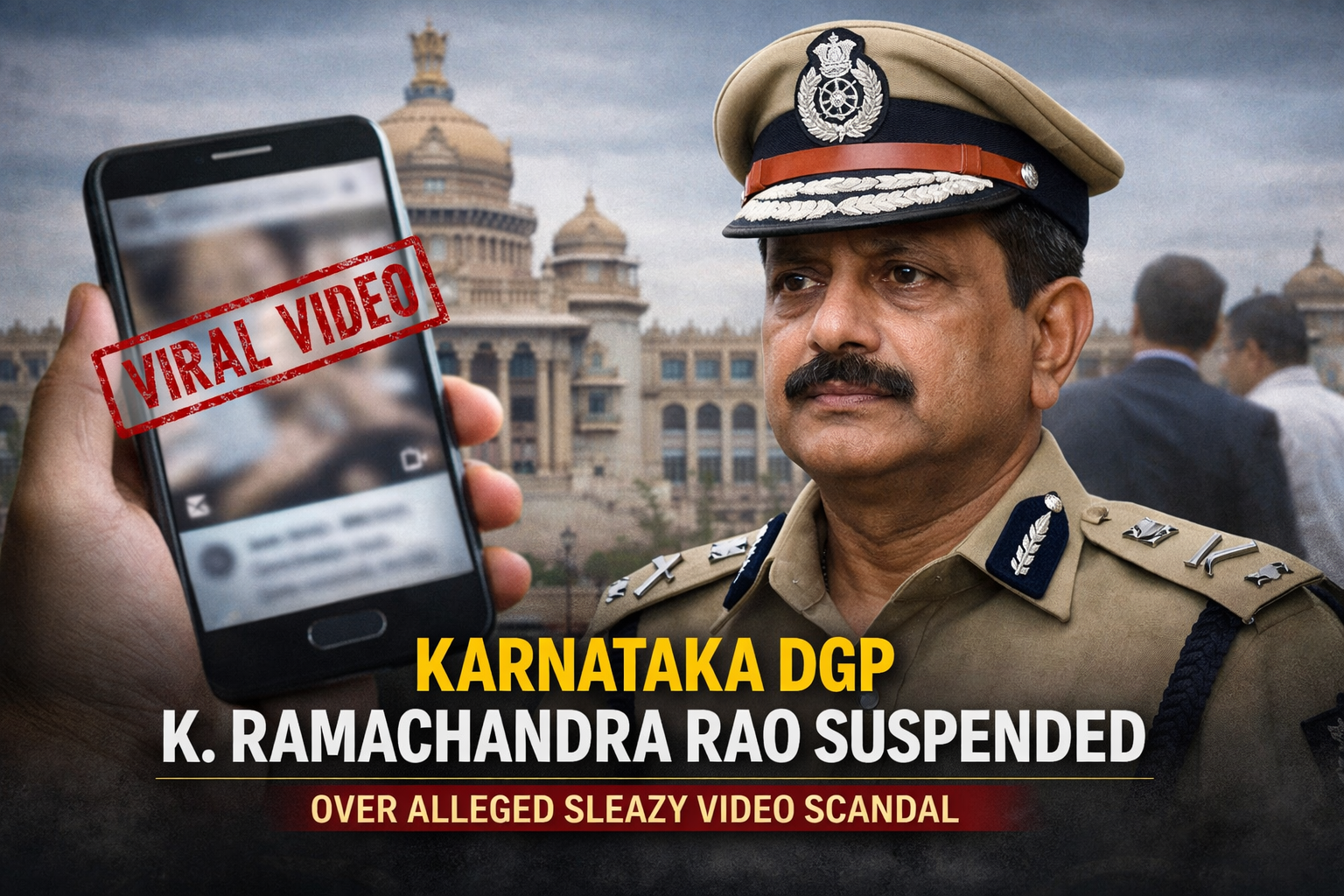
Senior IPS officer and Karnataka Director General of Police (Civil Rights Enforcement) K. Ramachandra Rao was suspended after alleged compromising videos involving him went viral on social media. The Karnataka government ordered a formal inquiry, citing conduct unbecoming of a government servant. Rao has denied the allegations, claiming the videos are fabricated, and the investigation will determine their authenticity, context, and any possible violations of service rules or law.
What happened?
On January 19-20, 2026, multiple unverified videos began circulating widely on social media and messaging platforms in Karnataka, allegedly showing senior IPS officer K. Ramachandra Rao—serving as Director General of Police (Civil Rights Enforcement)—in a compromising situation with women, reportedly in an office setting. The videos sparked popular indignation, political criticism, and swift administrative action from the state government.
Government action: suspension and inquiry.
Following the viral footage, the Karnataka government suspended Rao and requested a full investigation into the matter. According to reports on the suspension, the order described the alleged conduct as "unbecoming of a government servant" and stated that it caused humiliation to the government—language that is commonly used in service/disciplinary contexts to justify immediate suspension while an investigation is launched.
Multiple publications also reported that Chief Minister Siddaramaiah publicly stated that action would be taken based on the inquiry's findings, emphasizing accountability.
Rao's response: denial and a "fabricated" claim.
Rao has rejected the validity of the viral footage, describing the films as "fabricated" and untrue, claiming they are being exploited to ruin his image. According to several accounts, he disputed both the origin and veracity of the video and stated that he would take legal action after talking with attorneys.
This denial is noteworthy because it brings the matter to the junction of:
- Departmental misconduct allegations and
- Digital evidence integrity includes the possibility of modified or manipulated media.
Complaints, political reactions, and more scrutiny.
As the story gathered popularity, sources indicated that complaints were made and scrutiny increased from all sides, including opposition leaders and civil society voices demanding openness, accountability, and a timely investigation. Some reports reportedly cite further circulating material (including audio snippets), which fuelled the debate and calls for action.
At this point, it's worth noting that the films extensively described in media stories have not been verified in public reporting, and the inquiry is intended to determine authenticity, context, and responsibility.
Why does suspension occur soon in such cases?
In India, when charges against a highly senior official cause significant public concern, particularly when the alleged conduct threatens the integrity of an office, governments frequently utilize suspension as an interim administrative measure. It is not sufficient to establish guilt. Suspension typically
- Removes the officer from a position of authority during the investigation,
- Reduces the possibility of manipulating witnesses or records.
- indicates an institutional response to reputational injury.
Key questions the inquiry is expected to investigate
Based on how such probes are often structured—and what news has highlighted—the investigation will likely focus on:
-
Authenticity and origin of the videos
Where and when it was captured, the device/source trail, potential edits, and indicators of manipulation/deepfake. -
Location and circumstances.
Whether it occurred in an official location, at an official time, and if any government property or resources were involved. -
Service Conduct and Discipline
Whether the claimed activity violates the conduct guidelines that apply to government employees and IPS officers. -
Potential criminal angle (if any)
Only if evidence points to coercion, privacy infringement, extortion, or other offenses committed by the person or those who created/distributed material illegally.
This contradiction has already been overlooked in media reports: Rao's "fabricated" claim versus the government's determination that the charges were severe enough to warrant suspension and an investigation.
What happens next? (Typical process)
While the specific procedures depend on the state's orders and the inquiry authority, the common approaches include:
- a departmental investigation report including conclusions on authenticity and conduct.
- Possible disciplinary proceedings if wrongdoing is established.
- Possible criminal investigation if the probe exposes offenses such as illegal recording/distribution, blackmail, or other infractions.
- Depending on service regulations and proof, possible outcomes range from reinstatement (if not proven) to substantial fines (if proven).
Conclusion
Karnataka's suspension of DGP (Civil Rights Enforcement) K. Ramachandra Rao underscores the intensity of the state's response to the viral claims, as well as the perceived institutional danger of putting a senior officer in charge while questions remain unresolved. Rao's unequivocal denial and claim of fabrication make digital forensics and evidentiary review critical to the case. The ultimate decision will be based on what investigators discover regarding the content's legitimacy, context, and any rule or law infractions.
Sources
- NDTV — Karnataka Top Cop K Ramachandra Rao Suspended Over Alleged Viral Sleazy Videos
- The Indian Express — Senior Karnataka IPS officer suspended over viral video
- Deccan Herald — Karnataka top police officer suspended after sleazy videos surface
- The News Minute — Explicit videos allegedly involving Karnataka DGP surface, CM orders probe
- The New Indian Express — Viral sleazy video: Karnataka DGP Ramachandra Rao suspended