Rahul Gandhi vs Narendra Modi: India-US Trade Deal Sparks Political Storm in Parliament
Quick Summary
Rahul Gandhi’s sharp criticism of Prime Minister Narendra Modi over the India–US trade agreement has triggered major political unrest in Parliament. Accusing the government of surrendering national and farmers’ interests, Gandhi’s remarks led to repeated adjournments, MP suspensions, and intense BJP–Congress clashes. The controversy has fueled nationwide debate, divided public opinion, and raised questions about India’s foreign policy approach ahead of upcoming elections.
Introduction: Storm in Indian Politics
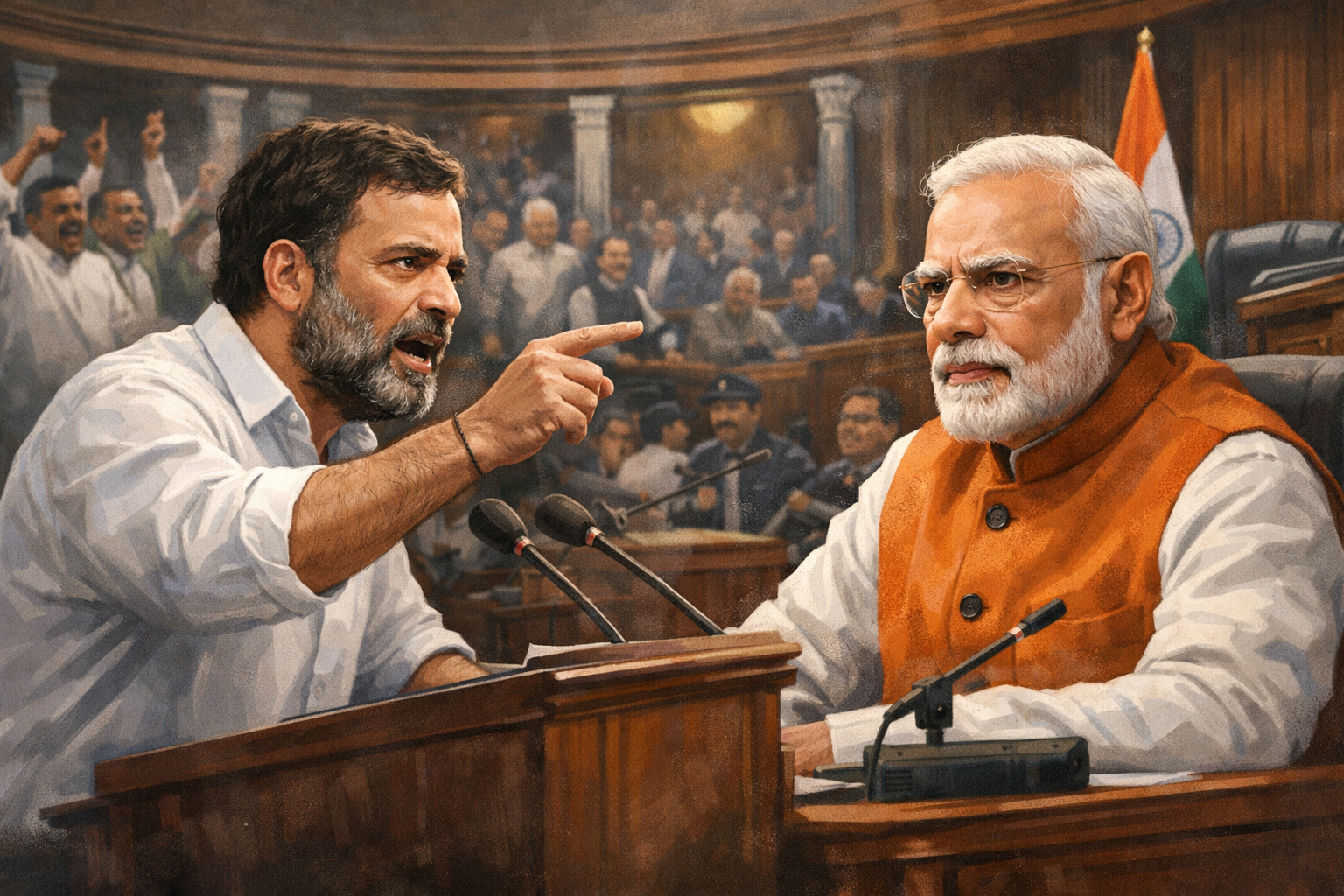
Congress politician and Leader of the Opposition (LoP) Rahul Gandhi’s strong attacks on Prime Minister Narendra Modi sparked a major political storm in early February 2026. Gandhi accused Modi of being “compromised” and “selling out” India’s interests, particularly those of farmers, in relation to the newly announced India–US trade agreement. The controversy dominated headlines and led to severe disruptions in Parliament, including adjournments, MP suspensions, and intense confrontations between the Bharatiya Janata Party (BJP) and the opposition. By February 5, 2026, the issue had become one of the most discussed topics across India, triggering debates on social media, news channels, and international platforms. This blog explores the origins of the controversy, the main allegations, the immediate fallout, and its implications for India’s political future.
The Spark: An India–US Trade Deal Announcement
The controversy began after US President Donald Trump announced a new trade agreement with India, claiming it would boost American agricultural exports. According to BJP leaders, the agreement—finalized after months of negotiations—excludes sensitive sectors such as agriculture and dairy from major concessions. Union Minister Piyush Goyal defended the deal in Parliament, stating that India had “successfully safeguarded” critical sectors. However, opposition leaders, led by Rahul Gandhi, viewed the agreement as a rushed compromise driven by external pressure.
Gandhi intensified his criticism on February 3, 2026, alleging that Prime Minister Modi consented to the deal under “immense pressure.” He argued that negotiations had not fundamentally changed, yet the government quickly agreed, suggesting hidden influences. This narrative aligns with broader opposition criticism of Modi’s foreign policy, often described as “huglomacy” by Congress leaders like Jairam Ramesh, who demanded a detailed parliamentary debate on the agreement. Ramesh accused Modi of “completely surrendering” India’s interests, reinforcing Gandhi’s claim that the Prime Minister had “sold the country.”
Key Allegations: “Compromised” PM and Hidden Pressures
Central to Gandhi’s attack is the assertion that Prime Minister Modi is “compromised.” Speaking to the media, Gandhi pointed to two alleged pressure points: the ongoing US court proceedings involving Gautam Adani, a businessman often linked with the BJP, and references to the Epstein files. He suggested these issues could damage Modi’s carefully constructed public image, built with “thousands of crores,” and that foreign powers might be exploiting them to extract concessions.
Gandhi further linked the trade deal to Modi’s alleged reluctance to face parliamentary scrutiny. He claimed the Prime Minister was “too afraid” to allow discussion on sensitive matters, including former Army Chief General M.M. Naravane’s unpublished memoir, which reportedly addresses the 2020 India–China border clashes. Attempts to raise this issue in the Lok Sabha resulted in chaos, with BJP MPs disrupting proceedings. Outside Parliament, Gandhi’s public confrontation with Union Minister Ravneet Singh Bittu further escalated tensions.
While Gandhi has previously targeted the Modi government over the Adani issue, linking these allegations to the trade agreement and Epstein references marked a sharper and more personal line of attack, portraying the Prime Minister as politically vulnerable and under pressure.
Parliamentary Chaos: Adjournments, Suspensions, and Protests
The fallout in Parliament was immediate and intense. The Lok Sabha was adjourned multiple times between February 3 and 4, 2026, amid opposition protests and sloganeering. Eight Congress MPs were suspended for the remainder of the session after attempting to surround the Prime Minister’s chair and repeatedly interrupt proceedings. Gandhi shared videos on social media, claiming he had anticipated Modi’s absence from Parliament due to these issues.
The BJP strongly rejected Gandhi’s allegations, calling them “baseless conspiracy theories” aimed at damaging India’s global reputation. Party leaders questioned whether Congress was acting “in India’s interest or against it,” dismissing Gandhi’s approach as politically desperate. Congress countered by stating that Modi’s statement in Parliament was meaningless unless the Leader of the Opposition was allowed to speak, arguing that genuine debate requires opposition participation.
This episode added to ongoing tensions, including BJP accusations that Gandhi skips national events such as the Beating Retreat ceremony, alleging he places “ego above nation.” The opposition, however, views these claims as attempts to divert attention from substantive issues and silence dissent.
Broader Political Fallout: Strategy, Elections, and Public Perception
The impact of this controversy extends well beyond Parliament. For Congress, the aggressive posture represents a calculated political strategy. Following the 2024 elections, Rahul Gandhi worked to reshape his image through initiatives like the Bharat Jodo Yatra, emphasizing anti-cronyism and national unity. By framing the trade agreement as a “surrender” under pressure, Congress positions itself as a defender of national interests—an argument that may resonate amid concerns over farmer welfare and tariff policies.
On the BJP side, Modi’s silence has been interpreted as either strategic restraint or political vulnerability. With the 2029 general elections on the horizon, this confrontation could help consolidate opposition alliances, though it also risks alienating moderate voters if perceived as overly conspiratorial.
Public reaction remains divided. Hashtags like #CompromisedModi have trended on social media, while BJP supporters rally around claims of national sovereignty. Economically, analysts continue to debate the agreement’s potential impact on Indian farmers, markets, and the rupee, with critics warning that the deal could disproportionately benefit US producers.
Conclusion: What Happens Next in This Political Saga?
Rahul Gandhi’s allegations have transformed the India–US trade agreement into the centerpiece of a high-stakes political battle, highlighting deeper tensions in India’s governance and foreign policy debates. As Parliament continues its sessions, further disruptions and confrontations appear likely. Whether these claims influence voter sentiment ahead of state elections and the 2029 general polls remains to be seen.
For now, Prime Minister Modi’s silence speaks volumes. In politics, silence can be as powerful as speech. Whether this episode leads to greater transparency or deeper divisions will depend on how the debate unfolds—possibly within a full-fledged parliamentary discussion. Stay tuned as this political story continues to evolve.