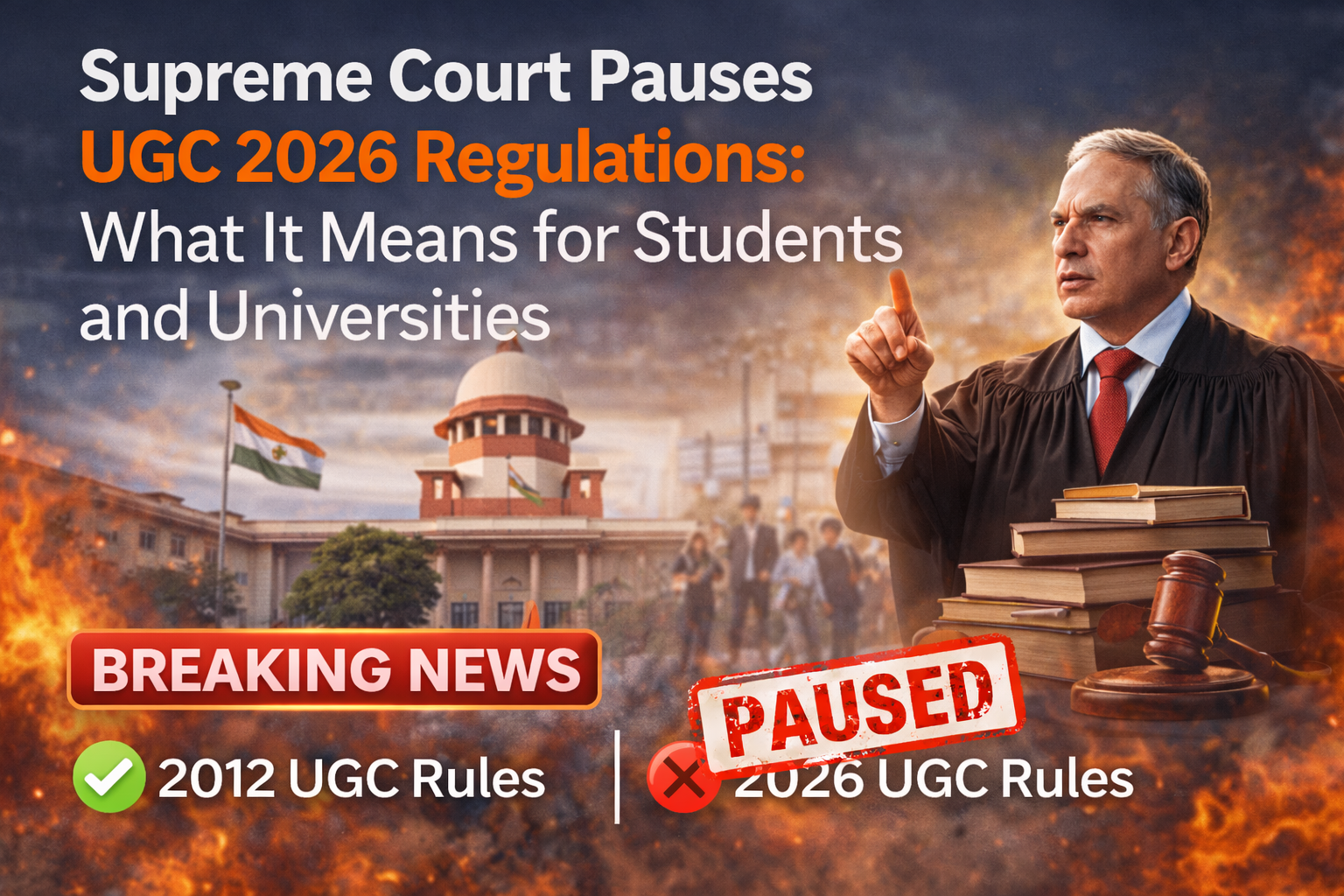
Supreme Court Pauses UGC 2026 Regulations: What It Means for Students and Universities
Quick Summary
The Supreme Court of India has temporarily stayed the implementation of the UGC’s 2026 equity regulations, citing concerns over ambiguity and potential misuse. The court has restored the 2012 UGC rules until further hearings scheduled for March 19, 2026. The decision has sparked mixed reactions across the education sector and highlights the ongoing debate over equity, inclusivity, and constitutional safeguards in higher education.
Supreme Court Pauses UGC 2026 Regulations: What It Means for Higher Education
Supreme Court Halts Implementation of UGC 2026 Regulations
New Delhi, January 29, 2026 — The Supreme Court of India has temporarily stayed the implementation of the University Grants Commission’s (UGC) 2026 regulations, formally known as the Promotion of Equity in Higher Education Institutions Regulations, 2026.
This decision marks a significant judicial intervention in the ongoing national debate surrounding higher education policy, equity measures, and constitutional rights within academic institutions.
What Did the Supreme Court Decide?
The Supreme Court’s order effectively pauses the enforcement of the 2026 UGC regulations and restores the earlier 2012 UGC regulations until further hearings are concluded.
The court has scheduled the next hearing in the matter for March 19, 2026. Until then, the 2012 regulations will continue to govern issues related to equity and discrimination in higher education institutions.
Why Were the UGC 2026 Regulations Challenged?
The 2026 UGC regulations were introduced with the stated aim of promoting equity, inclusivity, and protection against discrimination in universities and colleges. A key feature of the regulations was the mandatory formation of equity committees in all institutions.
These committees were required to include representatives from Scheduled Castes (SC), Scheduled Tribes (ST), Other Backward Classes (OBCs), persons with disabilities, and women.
However, multiple petitions filed before the Supreme Court raised concerns that the regulations narrowly defined caste-based discrimination, potentially excluding individuals from general (non-reserved) categories who may also face bias. Petitioners also argued that the language of the regulations was vague and open to misuse, raising questions about fairness and constitutional validity.
Supreme Court’s Observations and Reasoning
A bench headed by Chief Justice of India Surya Kant, along with Justice Joymalya Bagchi, examined the petitions and expressed concerns about the clarity and scope of the 2026 regulations.
The court observed that certain provisions appeared ambiguous and could be misused. It emphasized the importance of maintaining a casteless and unified academic environment, warning that poorly drafted rules could unintentionally create divisions or segregation within institutions.
To address these concerns, the court suggested that the regulations be reviewed by a committee of legal experts or eminent jurists to ensure they are inclusive, precise, and constitutionally sound.
Reactions from the Education Sector
The Supreme Court’s decision triggered mixed reactions across the education sector. Several student groups and activists welcomed the pause, stating that the regulations lacked adequate safeguards for students from general categories.
Some stakeholders described the ruling as a necessary corrective step to ensure fairness and prevent potential misuse of grievance mechanisms.
Education administrators and legal experts largely viewed the stay as an opportunity for broader consultation, deeper legal scrutiny, and refinement of the proposed reforms before long-term implementation.
What Happens Next?
The Supreme Court has issued notices to the UGC and the Government of India, seeking detailed explanations and justifications for the 2026 regulations.
The matter will be heard again on March 19, 2026, when further legal and constitutional arguments will be presented. Until then, the UGC’s 2012 regulations will remain in force, continuing to guide anti-discrimination and equity-related policies in higher education across the country.